
Ted Long Ted Long
0 Course Enrolled • 0 Course CompletedBiography
New AI-102 Exam Dumps Free | Pass-Sure AI-102: Designing and Implementing a Microsoft Azure AI Solution 100% Pass
2026 Latest Prep4sureGuide AI-102 PDF Dumps and AI-102 Exam Engine Free Share: https://drive.google.com/open?id=1bqtStbj9B4lWmGu1SOE0Lmj4TZ4jsIuo
The Designing and Implementing a Microsoft Azure AI Solution (AI-102) PDF dumps format can be accessed from any smart device such as laptops, tablets, and smartphones. Prep4sureGuide regularly updates the Microsoft AI-102 PDF Questions to reflect the latest Microsoft AI-102 exam content. All test questions in the Designing and Implementing a Microsoft Azure AI Solution (AI-102) exam PDF format are real and latest.
The Microsoft AI-102 Exam covers various topics related to AI, including natural language processing, computer vision, decision-making, and speech recognition. It also tests the candidate's ability to design and implement solutions using Azure AI services such as Azure Cognitive Services, Azure Bot Service, Azure Machine Learning, and Azure Databricks.
Microsoft AI-102 Exam Syllabus Topics:
| Topic | Details |
|---|---|
Plan and Manage an Azure Cognitive Services Solution (15-20%) |
|
| Select the appropriate Cognitive Services resource | - select the appropriate cognitive service for a vision solution - select the appropriate cognitive service for a language analysis solution - select the appropriate cognitive Service for a decision support solution - select the appropriate cognitive service for a speech solution |
| Plan and configure security for a Cognitive Services solution | - manage Cognitive Services account keys - manage authentication for a resource - secure Cognitive Services by using Azure Virtual Network - plan for a solution that meets responsible AI principles |
| Create a Cognitive Services resource | - create a Cognitive Services resource - configure diagnostic logging for a Cognitive Services resource - manage Cognitive Services costs - monitor a cognitive service - implement a privacy policy in Cognitive Services |
| Plan and implement Cognitive Services containers | - identify when to deploy to a container - containerize Cognitive Services (including Computer Vision API, Face API, Languages, Speech, Form Recognizer) - deploy Cognitive Services Containers in Microsoft Azure |
Implement Computer Vision Solutions (20-25%) |
|
| Analyze images by using the Computer Vision API | - retrieve image descriptions and tags by using the Computer Vision API - identify landmarks and celebrities by using the Computer Vision API - detect brands in images by using the Computer Vision API - moderate content in images by using the Computer Vision API - generate thumbnails by using the Computer Vision API |
| Extract text from images | - extract text from images or PDFs by using the Computer Vision service - extract information using pre-built models in Form Recognizer - build and optimize a custom model for Form Recognizer |
| Extract facial information from images | - detect faces in an image by using the Face API - recognize faces in an image by using the Face API - analyze facial attributes by using the Face API - match similar faces by using the Face API |
| Implement image classification by using the Custom Vision service | - label images by using the Computer Vision Portal - train a custom image classification model in the Custom Vision Portal - train a custom image classification model by using the SDK - manage model iterations - evaluate classification model metrics - publish a trained iteration of a model - export a model in an appropriate format for a specific target - consume a classification model from a client application - deploy image classification custom models to containers |
| Implement an object detection solution by using the Custom Vision service | - label images with bounding boxes by using the Computer Vision Portal - train a custom object detection model by using the Custom Vision Portal - train a custom object detection model by using the SDK - manage model iterations - evaluate object detection model metrics - publish a trained iteration of a model - consume an object detection model from a client application - deploy custom object detection models to containers |
| Analyze video by using Azure Video Analyzer for Media (formerly Video Indexer) | - process a video - extract insights from a video - moderate content in a video - customize the Brands model used by Video Indexer - customize the Language model used by Video Indexer by using the Custom Speech service - customize the Person model used by Video Indexer - extract insights from a live stream of video data |
Implement Natural Language Processing Solutions (20-25%) |
|
| Analyze text by using the Language service | - retrieve and process key phrases - retrieve and process entity information (people, places, urls, etc.) - retrieve and process sentiment - detect the language used in text |
| Manage speech by using the Speech service | - implement text-to-speech - customize text-to-speech - implement speech-to-text - improve speech-to-text accuracy - improve text-to-speech accuracy - implement intent recognition |
Training Microsoft AI-102 Solutions | Sample AI-102 Questions
Additionally, students can take multiple Microsoft AI-102 exam questions, helping them to check and improve their performance. Three formats are prepared in such a way that by using them, candidates will feel confident and crack the Designing and Implementing a Microsoft Azure AI Solution (AI-102) actual exam. These three formats suit different preparation styles of AI-102 test takers.
Microsoft Designing and Implementing a Microsoft Azure AI Solution Sample Questions (Q198-Q203):
NEW QUESTION # 198
You are building a chatbot by using the Microsoft Bot Framework Composer.
You have the dialog design shown in the following exhibit.
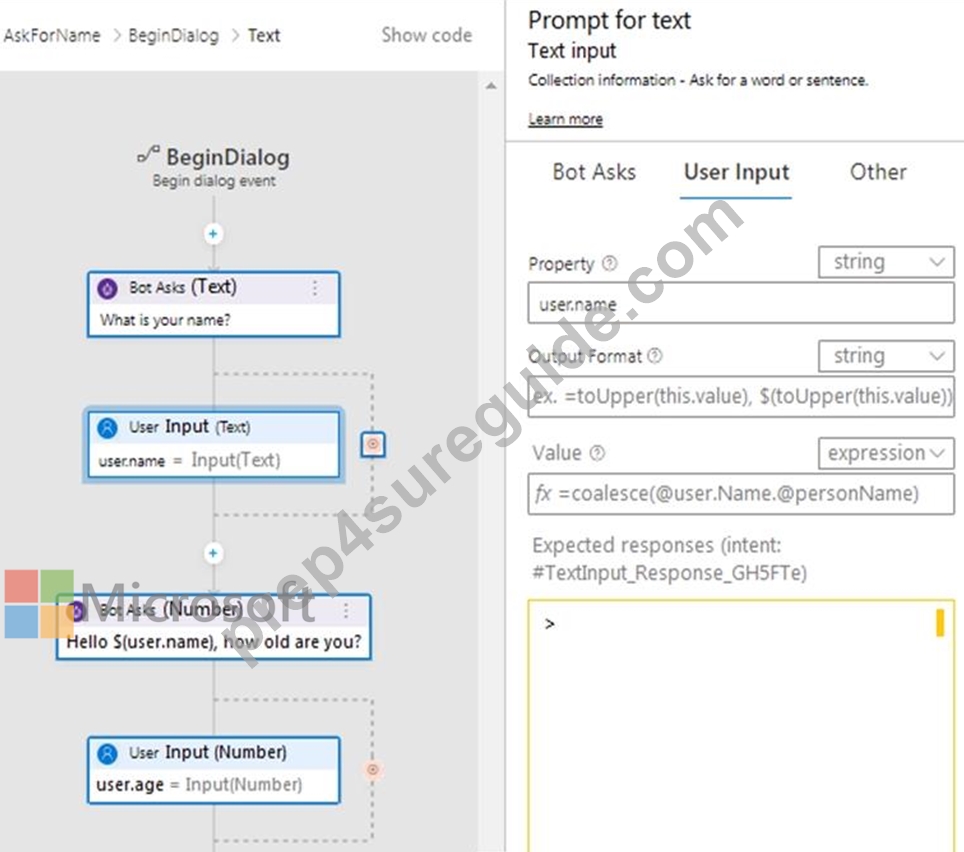
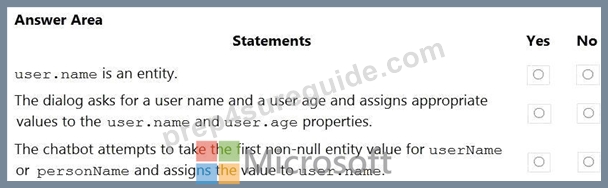
For each of the following statements, select Yes if the statement is true. Otherwise, select No.
NOTE: Each correct selection is worth one point.
Answer:
Explanation:
Explanation:
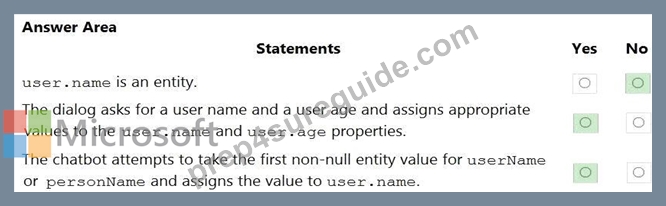
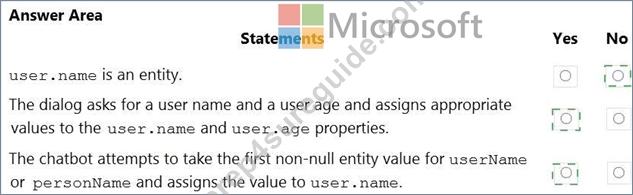
Box 1: No
User.name is a property.
Box 2: Yes
Box 3: Yes
The coalesce() function evaluates a list of expressions and returns the first non-null (or non-empty for string) expression.
Reference:
https://docs.microsoft.com/en-us/composer/concept-language-generation
https://docs.microsoft.com/en-us/azure/data-explorer/kusto/query/coalescefunction
NEW QUESTION # 199
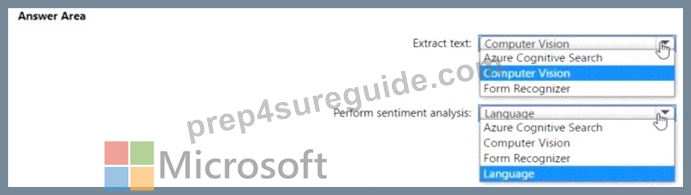
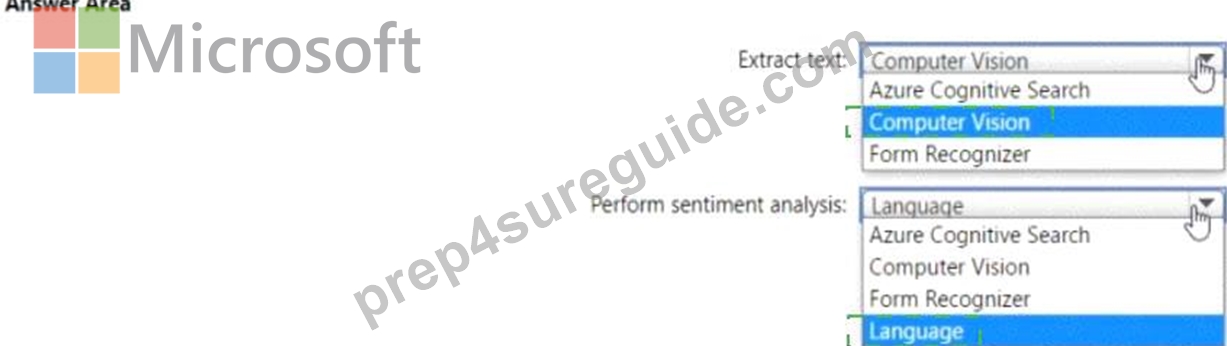
You have a collection of press releases stored as PDF files.
You need to extract text from the files and perform sentiment analysis.
Which service should you use for each task? To answer, select the appropriate options in the answer area.
NOTE: Each correct selection is worth one point.
Answer:
Explanation:
Explanation:

NEW QUESTION # 200
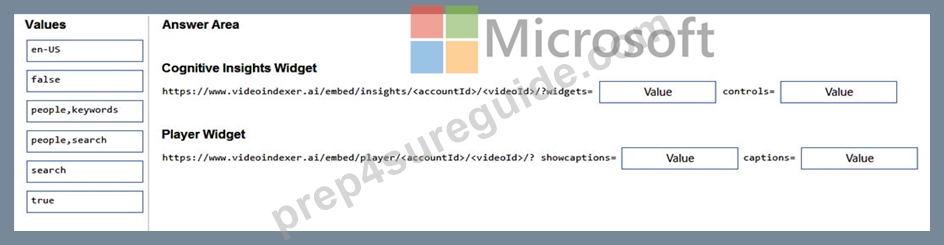
You are developing a webpage that will use the Video Indexer service to display videos of internal company meetings.
You embed the Player widget and the Cognitive Insights widget into the page.
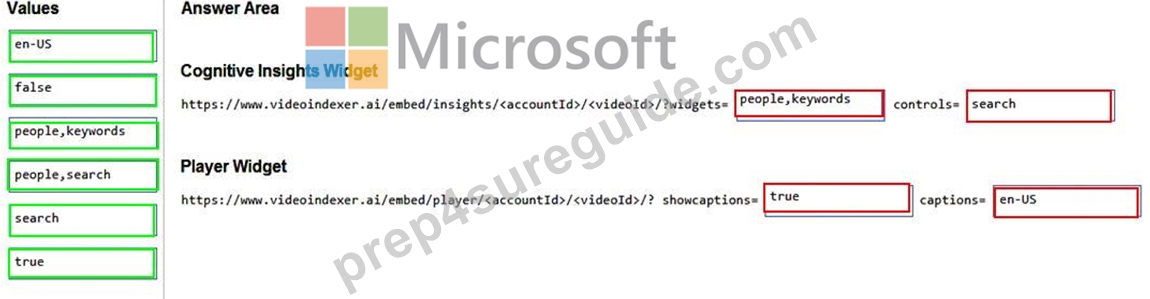
You need to configure the widgets to meet the following requirements:
Ensure that users can search for keywords.
Display the names and faces of people in the video.
Show captions in the video in English (United States).
How should you complete the URL for each widget? To answer, drag the appropriate values to the correct targets. Each value may be used once, more than once, or not at all. You may need to drag the split bar between panes or scroll to view content.
NOTE: Each correct selection is worth one point.
Answer:
Explanation:
NEW QUESTION # 201
You have an Azure subscription that contains an Azure Al Foundry Content Safety resource named resource1.
You are building an app that will analyze text by using resource1.
You need to identify text that contains hateful content.
How should you complete the code? To answer, select the appropriate options in the answer area.
NOTE: Each correct selection is worth one point.
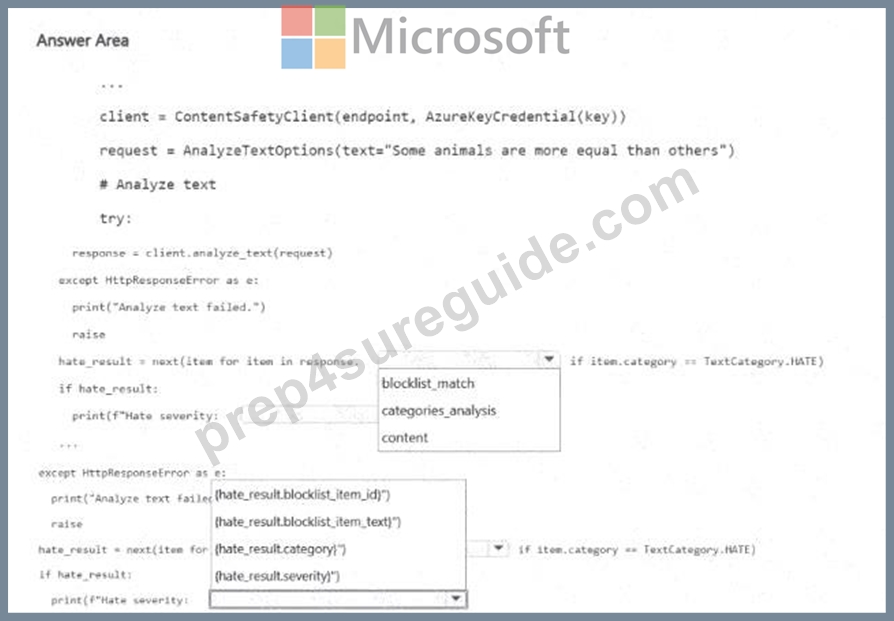
Answer:
Explanation:
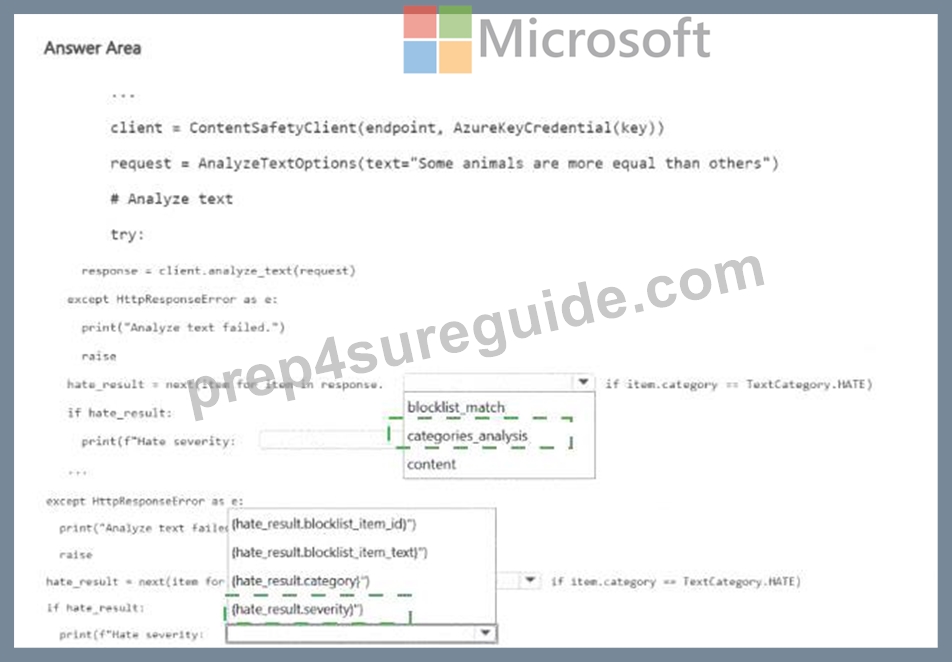
Explanation:
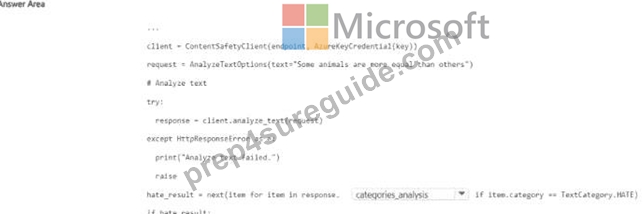

To detect hateful content with Azure AI Foundry Content Safety - Text , you should read the category analysis results returned by the analyze_text call. The response exposes a collection named categories_analysis, where each item contains the analyzed category (e.g., TextCategory.HATE) and its severity level.
Hence:
* Iterate over response.categories_analysis, filter the item where item.category == TextCategory.HATE.
* Print the severity using hate_result.severity.
This uses category analysis (not blocklist matches), which is the correct mechanism for detecting hate content with a severity score.
Microsoft References
* Azure AI Content Safety - Analyze text (Python quickstart/samples): iterate response.
categories_analysis, check TextCategory.HATE, read item.severity.
* Azure AI Content Safety - Text categories and severity levels: explains categories (Hate, Violence, Sexual, Self-harm) and severity output.
NEW QUESTION # 202
Select the answer that correctly completes the sentence.

Answer:
Explanation:

Explanation:

NEW QUESTION # 203
......
Unlike those impotent practice materials, our AI-102 study questions have salient advantages that you cannot ignore. They are abundant and effective enough to supply your needs of the AI-102 exam. Since we have the same ultimate goals, which is successfully pass the AI-102 Exam. So during your formative process of preparation, we are willing be your side all the time. As long as you have questions on the AI-102 learning braindumps, just contact us!
Training AI-102 Solutions: https://www.prep4sureguide.com/AI-102-prep4sure-exam-guide.html
- Composite Test AI-102 Price 🏄 AI-102 Clearer Explanation 🦊 Valid Test AI-102 Fee 🔲 Go to website ✔ www.practicevce.com ️✔️ open and search for ▛ AI-102 ▟ to download for free 🍲AI-102 Reliable Test Braindumps
- Try Microsoft AI-102 Questions To Clear Exam in First Endeavor 🧷 Download ➽ AI-102 🢪 for free by simply entering ⮆ www.pdfvce.com ⮄ website 🍧AI-102 Certified
- Free PDF 2026 AI-102: Authoritative Designing and Implementing a Microsoft Azure AI Solution Exam Dumps Free 😬 Search for 《 AI-102 》 and download it for free on ⇛ www.examcollectionpass.com ⇚ website 🐭AI-102 Certified
- Exam AI-102 Cost 🍯 AI-102 Test Study Guide ⏯ Exams AI-102 Torrent 🐼 Enter ▛ www.pdfvce.com ▟ and search for ➽ AI-102 🢪 to download for free 🕉AI-102 Flexible Learning Mode
- Reliable AI-102 Study Notes 🎒 Valid Test AI-102 Fee 👵 Valid AI-102 Study Materials 🪀 Open website [ www.easy4engine.com ] and search for ▛ AI-102 ▟ for free download 🐓AI-102 Certified
- Excellent AI-102 Exam Questions make up perfect Study Brain Dumps - Pdfvce 🪁 Simply search for 【 AI-102 】 for free download on 【 www.pdfvce.com 】 🍨AI-102 Flexible Learning Mode
- AI-102 Labs 🦢 Accurate AI-102 Study Material 🔃 AI-102 Test Study Guide 😄 The page for free download of “ AI-102 ” on { www.examcollectionpass.com } will open immediately ⭐Reliable AI-102 Test Dumps
- Free PDF Microsoft AI-102 Exam Dumps Free With Interarctive Test Engine - Reliable Training AI-102 Solutions 🍔 Search on ⏩ www.pdfvce.com ⏪ for ☀ AI-102 ️☀️ to obtain exam materials for free download 🥉Exam AI-102 Cost
- AI-102 Pdf Vce - AI-102 Practice Torrent - AI-102 Study Material 🐗 Easily obtain 【 AI-102 】 for free download through “ www.examcollectionpass.com ” 🧁AI-102 Clearer Explanation
- AI-102 Certified 🔼 AI-102 Top Questions 😱 AI-102 Test Study Guide 🛴 Open website ➡ www.pdfvce.com ️⬅️ and search for ▷ AI-102 ◁ for free download 🍽AI-102 Labs
- Composite Test AI-102 Price 🥇 Reliable AI-102 Study Notes 🚲 Valid AI-102 Study Plan 🕴 Search for ➡ AI-102 ️⬅️ and obtain a free download on ➠ www.troytecdumps.com 🠰 🌱Composite Test AI-102 Price
- safapisz224476.blogdanica.com, adreaugrt887312.blogdun.com, zoeyzfg640377.blog2freedom.com, www.stes.tyc.edu.tw, nicolepjnr163218.tusblogos.com, socialrus.com, jaysonkmrm705584.homewikia.com, bookmarknap.com, caoimheklfe230052.kylieblog.com, aroniceb478741.blogdanica.com, Disposable vapes
BONUS!!! Download part of Prep4sureGuide AI-102 dumps for free: https://drive.google.com/open?id=1bqtStbj9B4lWmGu1SOE0Lmj4TZ4jsIuo